Across the world, coastal communities have developed their own delicious ways of cooking fresh fish.
In France, fish is gently simmered with potatoes and aromatic vegetables. In Korea, mackerel is braised with thick slices of radish in a rich, spicy sauce.
The flavors are quite different, but these dishes share something special: fish and vegetables are cooked together, allowing their flavors to blend beautifully.
Today, we're traveling to Brittany, France, to discover Cotriade, a traditional French fish stew, and explore what it has in common with Korea's beloved Godeungeo Mu Jorim (Braised Mackerel with Radish).
Cotriade: A Traditional Fisherman's Stew from Brittany
Located in northwestern France, Brittany is a coastal region with a long fishing heritage.
Its cuisine reflects a close connection to the Atlantic Ocean, with seafood playing an important role in everyday meals.
One of the region's traditional dishes is Cotriade, a comforting fish stew made with several varieties of fish, potatoes, onions, and aromatic herbs.
Cotriade is especially associated with the port city of Lorient.
Traditionally, fishermen prepared the stew using portions of their daily catch, cooking the fish together with simple vegetables in a large pot.
While southern France is famous for Bouillabaisse, Brittany has its own seafood tradition in Cotriade.
Both dishes celebrate fresh fish, but each reflects the ingredients and cooking traditions of its region.
Did You Know Cotriade Can Be Made with Mackerel?
One interesting feature of Cotriade is that it doesn't require just one type of fish.
Depending on the recipe and local catch, cooks may use cod, hake, conger eel, or other varieties of fish.
Some recipes also include mussels and other seafood.
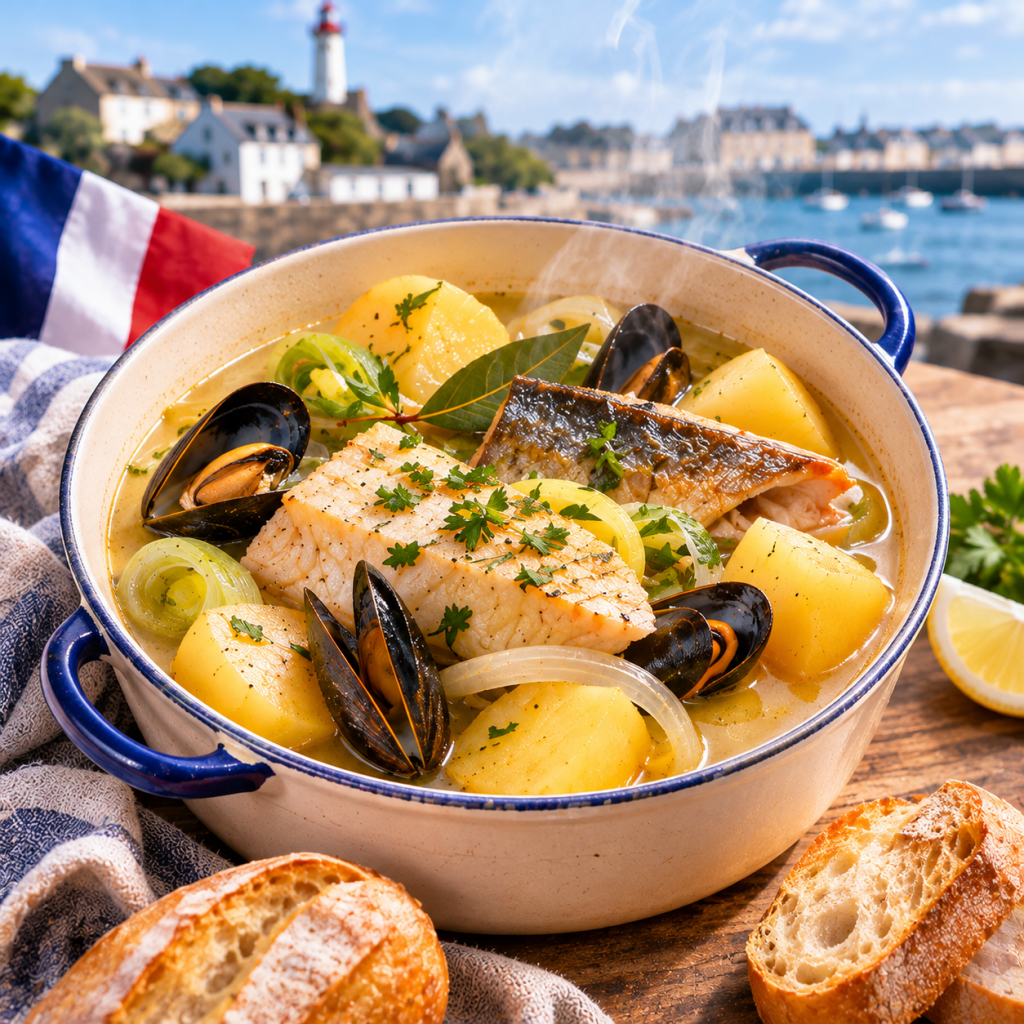
And here's an interesting connection to Korean cuisine: mackerel can also be used in Cotriade!
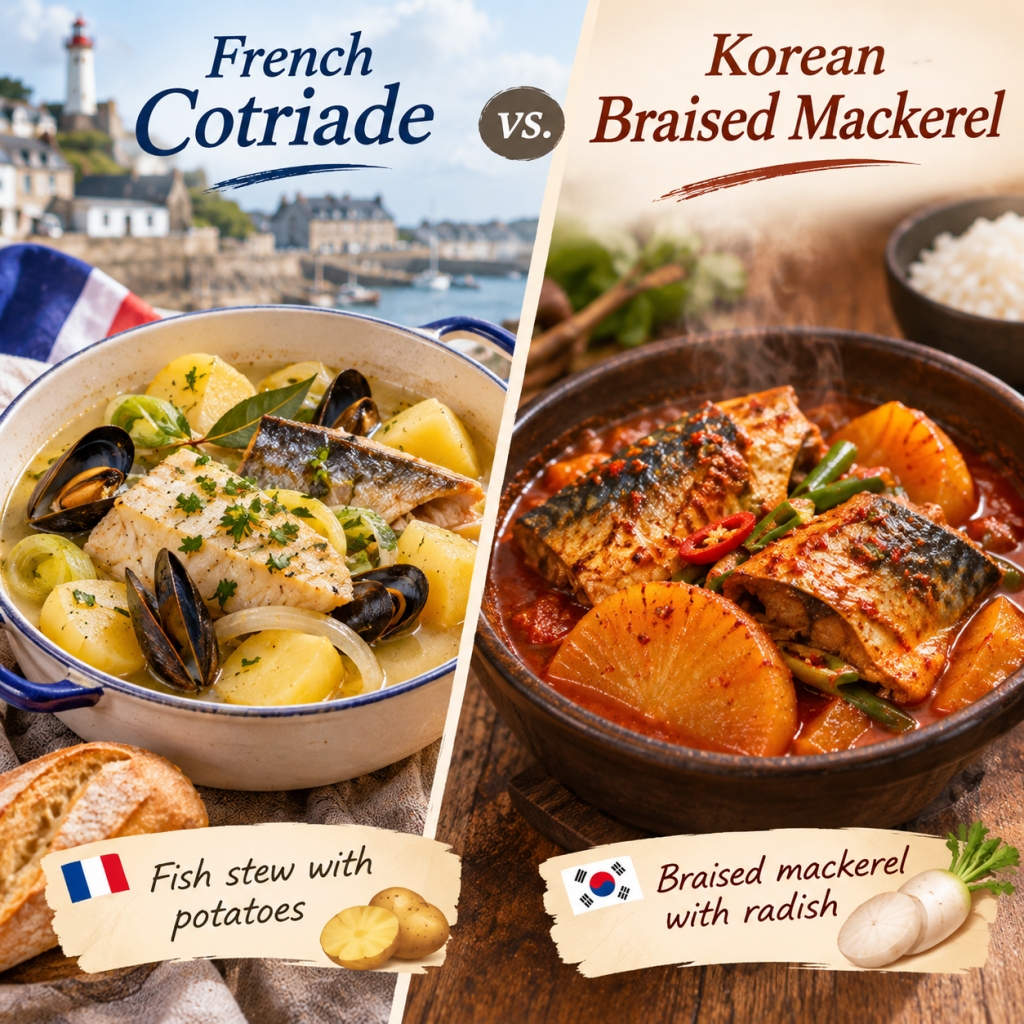
That makes it a fascinating dish to compare with Korean braised mackerel.
However, the seasonings create very different flavors.
French Cotriade typically highlights the natural taste of fish with ingredients such as butter, herbs, onions, and a light broth.
Korean braised mackerel, on the other hand, is cooked with gochugaru (Korean red pepper flakes), soy sauce, garlic, and other seasonings.
One is light and comforting, while the other is bold, savory, and spicy.
Potatoes in France, Radish in Korea!
Perhaps the most interesting difference between these two dishes is the vegetable cooked alongside the fish.
In French Cotriade, potatoes play an essential role.
They are usually cooked in the broth before the fish is added, becoming tender while absorbing the flavors of the stew.
Potatoes also make Cotriade a hearty and satisfying meal.
In Korean Godeungeo Mu Jorim, Korean radish plays a similar role.
Thick slices of radish are placed at the bottom of the pot, with mackerel arranged on top.
As everything simmers, the radish absorbs the savory fish juices and spicy braising sauce.
The result is soft, juicy radish packed with flavor.
In fact, many Koreans enjoy the braised radish just as much as the fish itself!
Cotriade's potatoes and Godeungeo Mu Jorim's radish may be different vegetables, but both help bring the dish together.
French Cotriade vs. Korean Braised Mackerel
| Feature | French Cotriade | Korean Godeungeo Mu Jorim |
|---|
| Origin | Brittany, France | Korea |
| Fish | Various fish, including mackerel in some recipes | Mackerel |
| Main vegetables | Potatoes, onions, leeks | Korean radish, onions, green onions |
| Cooking method | Simmered in broth | Braised in seasoned sauce |
| Key seasonings | Butter, herbs, salt, pepper | Gochugaru, soy sauce, garlic |
| Flavor | Light, savory, comforting | Spicy, rich, deeply savory
|
How to Make French Cotriade at Home
Want to try this traditional French fish stew?
Here's a home-friendly recipe inspired by the cooking traditions of Brittany.
Ingredients (Serves 4)
800 g–1 kg mixed fish, such as mackerel, cod, or hake
4 medium potatoes
2 onions
1 leek (white part)
2 garlic cloves
30 g butter
1 liter water or light fish stock
1 bay leaf
2 sprigs fresh thyme
Salt and black pepper, to taste
Fresh parsley, for garnish
300 g mussels (optional)
Instructions
STEP 1. Prepare the vegetables
Peel the potatoes and cut them into large chunks.
Thinly slice the onions and leek, and finely chop the garlic.
STEP 2. Sauté the aromatics
Melt the butter in a large pot over medium-low heat.
Add the onions, leek, and garlic, and cook gently until softened.
STEP 3. Cook the potatoes
Add the potatoes and stir briefly.
Pour in the water or fish stock, then add the bay leaf and thyme.
Simmer for approximately 15–20 minutes, or until the potatoes are nearly tender.
STEP 4. Add the fish
Cut the cleaned fish into large pieces and gently place them over the potatoes.
Simmer over low heat for approximately 8–10 minutes, adjusting the time according to the thickness and type of fish.
Avoid stirring too much to prevent the fish from breaking apart. Make sure the fish is fully cooked before serving.
STEP 5. Add the mussels (optional)
If using mussels, add them near the end of cooking.
Cover the pot and cook until the mussels open and are fully cooked. Discard any mussels that remain closed after cooking.
Season with salt and black pepper.
STEP 6. Serve and enjoy
Arrange the fish and potatoes in serving bowls and ladle the warm broth over them.
Garnish with fresh parsley and serve with crusty French bread.
In some traditional versions of Cotriade, the fish and potatoes are served separately from the broth, which is enjoyed with bread.
What If You Added Korean Radish to Cotriade?
Here's a delicious idea for anyone who enjoys experimenting in the kitchen.
What if you replaced some of the potatoes in Cotriade with Korean radish?
Korean radish becomes tender when simmered and can absorb the delicate flavors of fish broth.
Unlike potatoes, which have a soft, starchy texture, cooked Korean radish offers a juicy bite and a mild, subtly sweet flavor.
It could bring an interesting new dimension to this traditional French stew.
Of course, this would be a modern adaptation rather than an authentic Brittany recipe.
But it's a wonderful example of how Korean radish can fit into different cooking traditions around the world.
Next Week: Let's Make Korean Braised Mackerel with Radish!
French Cotriade and Korean Godeungeo Mu Jorim tell two different stories about cooking fish.
In France, potatoes simmer in a delicate seafood broth.
In Korea, radish absorbs the bold flavors of mackerel and spicy seasonings.
Different ingredients, different flavors, but the same comforting idea of bringing fish and vegetables together in one pot.
And in Korean cooking, radish is especially important.
As it slowly braises, it becomes tender and soaks up the rich flavors of the sauce, often becoming one of the most delicious parts of the meal.
Next week, we'll show you how to make Korean Braised Mackerel with Radish!
Stay tuned to discover how Korean radish transforms a classic Korean seafood dish.
Follow K-MU for more stories and recipes featuring Korean radish from around the world!


